
Every June the Romanian television mentions it.
A reporter stands on a stretch of mountain road, often still flanked by walls of cleared snow taller than a person, and announces that the Transfăgărășan is open again.
It happens every year. It is, by any normal definition, not news. A road that closes every winter has, predictably, reopened. And yet there is the segment, the reporter, sometimes a helicopter shot of the hairpins from above, the whole production treated with the seriousness of an event.
We grew up watching this and never once questioned it. Of course it was news. It still feels like news now.
To understand why, you have to go back to why the road exists at all, and the reason has nothing to do with tourism. In the early 1970s, after the Soviet Union sent tanks into Czechoslovakia to crush the Prague Spring, Ceaușescu looked at the map of Romania and did not like what he saw. The Carpathians cut the country in two, and if Soviet forces ever came the way they had come for the Czechs, there was no fast route for the Romanian army to move between Transylvania and Wallachia.
So he ordered one built. A route that could move an armoured division of roughly 2,000 vehicles into Transylvania within 24 hours of an attack. Six thousand soldiers spent over four years carving it.
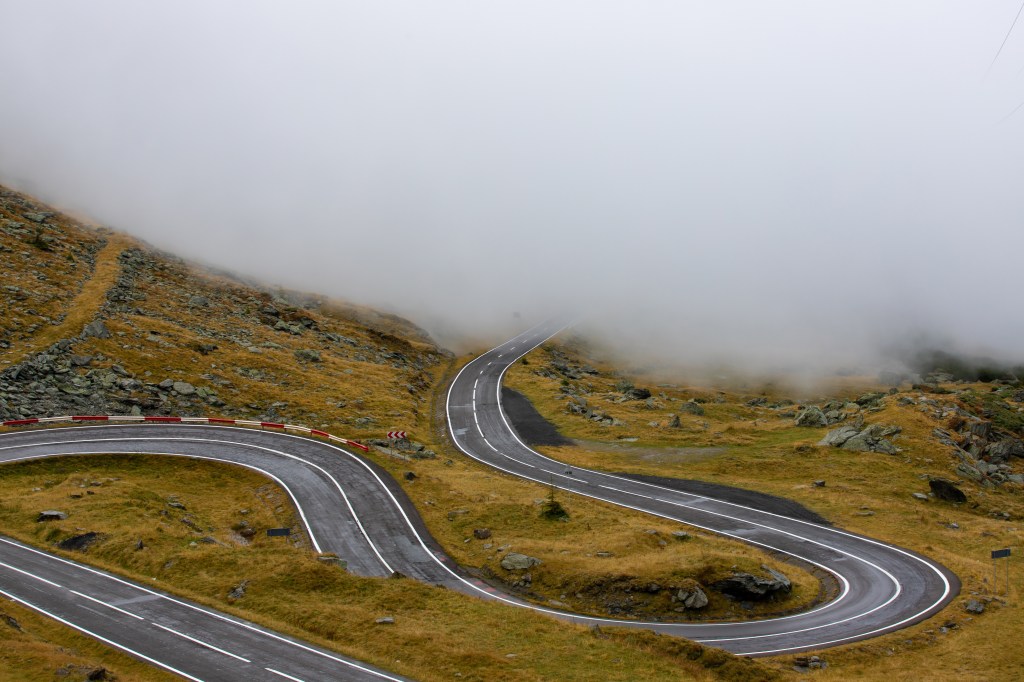
By the time it opened in 1974, the geopolitical moment that justified it had already moved on, the way these things tend to. What remained was 90 kilometres of road climbing to 2,042 metres, the second highest paved point in the country, through five tunnels and past rock faces that, fifty years later, still look like they were cut last week. Snow lingers on the verges well into July. The air at the top is thin enough that your ears do something strange and do not quite recover.
None of this makes it a comfortable drive. It makes it feel like an expedition, the kind of road that leaves you enchanted, with a story to tell and the photos to prove it.
Top Gear called it the best road in the world, and international visitors arrive expecting exactly that, a driving experience, switchbacks and views and the kind of road that exists in car adverts. What they often do not expect is the fog.
Somewhere along the climb, without warning, it arrives. One moment you are in full sun with the entire valley spread out below, green and gold and impossibly far away, and the next moment all of it is simply gone. The road ahead becomes something you take on faith rather than sight, a grey shape dissolving a few metres past the bonnet, and traffic slows almost in unison, the way people instinctively lower their voices when they walk into a quiet room.
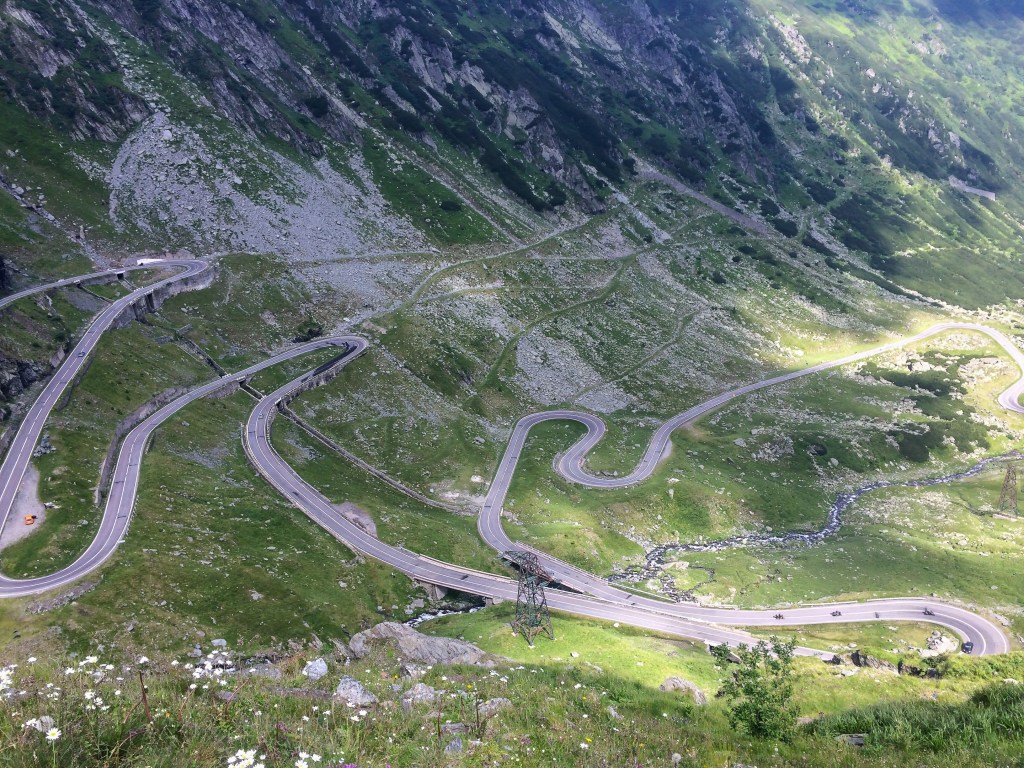
From above, on the rare clear day, the road looks almost ornamental, a single continuous line looping back on itself again and again, as if someone were testing how much could be drawn before the pen ran dry. From inside a car, each loop is a small negotiation. In slow, out slower. Tour buses execute three-point turns on bends engineered for armoured columns, and somehow it works, every time, until presumably it does not, which is part of why the road closes the moment the first real snow falls.
The high point is Bâlea Lake, glacial, dark, ringed by bare rock. Every winter, an entire hotel made of ice is built here from nothing, because the previous one has, by definition, melted into the lake it sits beside. In summer it is simply a lake, though a cable car still runs from the valley for anyone unwilling to drive the final stretch.
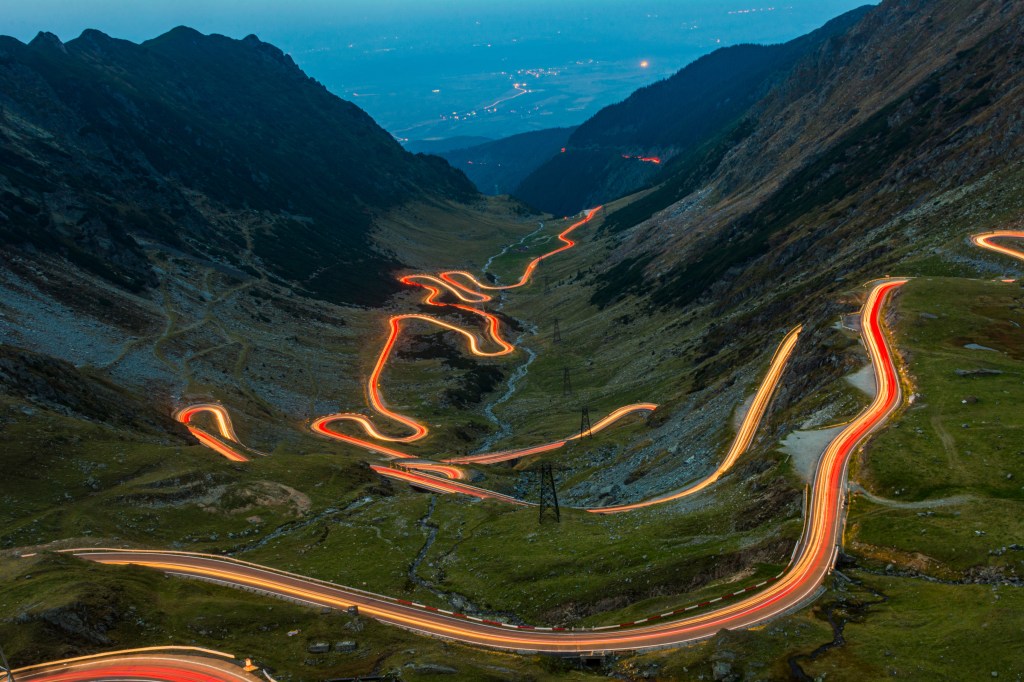
At night, the headlights below trace the same loops the road crews cut by hand half a century ago, a thin chain of light moving slowly through the dark, less like traffic and more like something migratory.
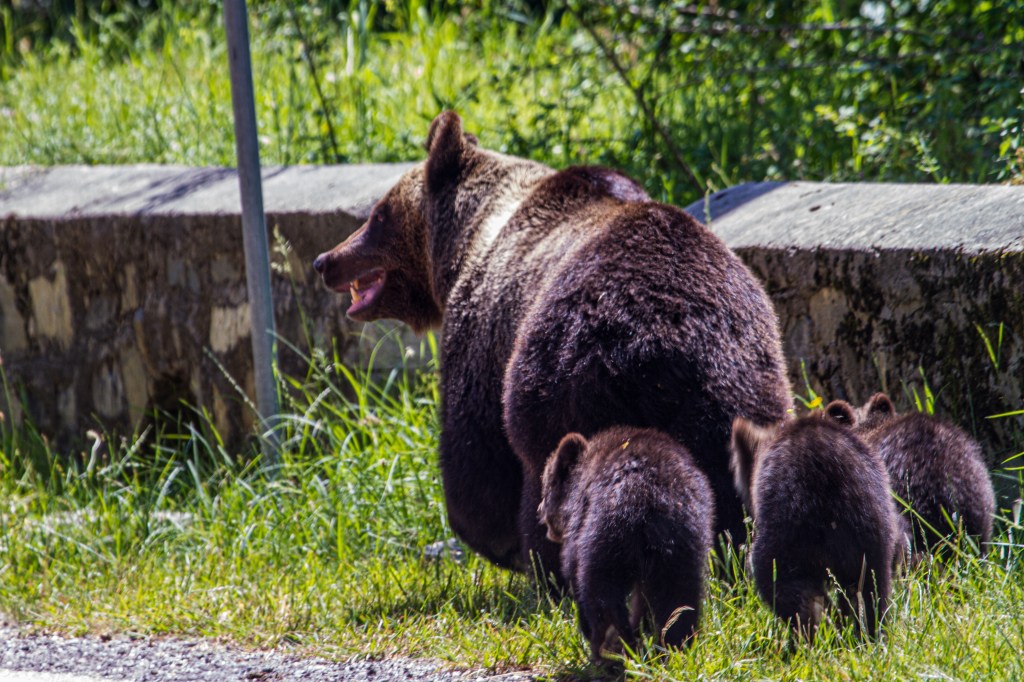
And somewhere on the way down, more often than you would think, there is a bear.
A mother, usually, with cubs trailing behind her along the verge, entirely unbothered by the cars slowing to watch. They come because tourists feed them, which is precisely the problem, and precisely why the advice is always the same: windows up, hands off the door handle, however good the photo would be.
She has no idea what any of this was built for. The tanks that never came, the explosives, the reporter standing on the tarmac every June with the same sentence ready to go. What she knows is that there is grass here, and sometimes food, and that the loud metal things mostly stay on the grey strip if left alone.
Want to drive it yourself? Here’s a day trip from Bucharest that includes the road, Bâlea Lake, and yes, possibly bears.
We have watched that June broadcast every year of our lives, the road reopening, treated as if it mattered, and it occurs to us now that maybe it always did. Not because of what the road was built for, but because of what it became instead. A road meant for an invasion that never came is now, fifty years on, the thing that makes people from other countries say the word Romania and mean something good by it.
That is worth a news segment. Every June, again.
This article is also available in French:
You might like:
- Romania Through Romanian Eyes
- Brasov, Romania: The City Where Every Square Feels Like a Holiday
- 48 Hours in Romania for Under 100 Euros
© 2026 Secrets of Romania. All rights reserved.
 Secrets of Romania