
You notice it before you can explain it, something about the rooftops that feels slightly wrong, until you place what it is. Windows, narrow and tilted at an angle, set into the slope of the roof, shaped unmistakably like eyes. Half closed. Watching.
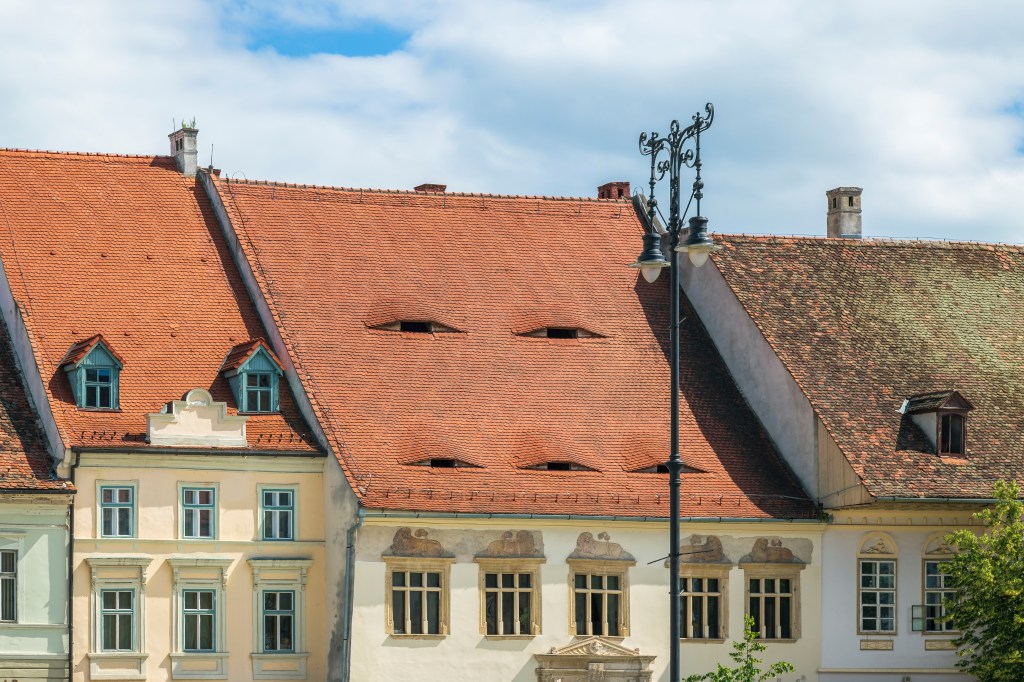
These are the Eyes of Sibiu, and once the first one registers, the rest follow on their own, whether you want them to or not. They began as ventilation for attics where grain, cheese and meat were once stored, a fifteenth century solution to a practical problem, except that whoever designed them gave the shutters a curve and a lid that made the whole thing look alive. Five centuries on, the attics are still dry, and walking under them does, in fact, feel a little like being watched.
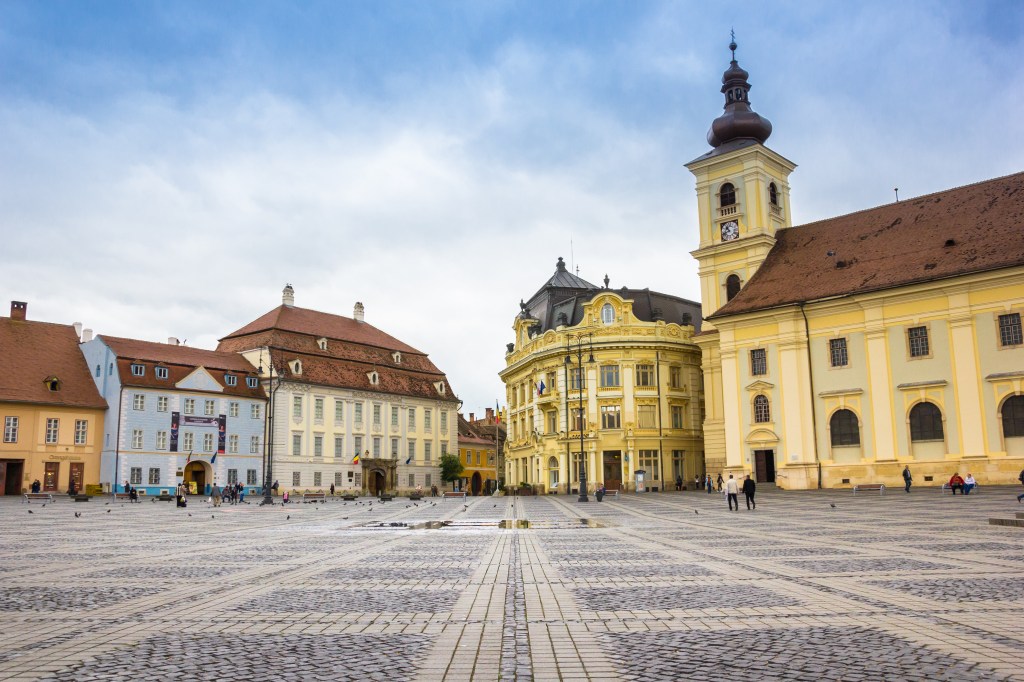
The city itself sits on two levels, an Upper Town and a Lower Town, joined by stairs and narrow passages that give the whole place a faint tilt, as though it were a stage set built on a slope nobody quite finished levelling. Most visitors begin in the Upper Town and rarely leave it, because this is where the three connected squares sit: Piața Mare, Piața Mică, and Piața Huet, each one opening into the next so gradually that the boundaries barely register.
Piața Mare is the largest of the three and the one most often photographed, pastel facades, uneven cobbles, and the Brukenthal Palace running along one entire side. Built in the late eighteenth century by a Transylvanian governor with what appears to have been excellent taste, it now holds the oldest museum in Romania, its rooms filled with Flemish and Italian paintings that feel oddly displaced this far from where they were made.
For a city this size, Sibiu has accumulated an unreasonable number of firsts. The first printing press in the country operated here, producing the first Romanian newspaper and, not long after, the first encyclopaedia. The first pharmacy in Romania opened here in 1494, which is why the Pharmacy Museum exists at all and is, against expectations, worth the ten minutes it takes to see it. For a stretch in the nineteenth century, this was effectively the administrative capital of Transylvania under the Habsburgs, which explains why the buildings look the way they do, built by people who expected the city to matter.
The Council Tower rises from one corner of the square, not tall by any serious measure, but tall enough, and the climb is short. From the top, the eyes are below you instead of above, rows of them across the rooftops, each pair angled slightly differently, like an audience that has not quite finished finding their seats.
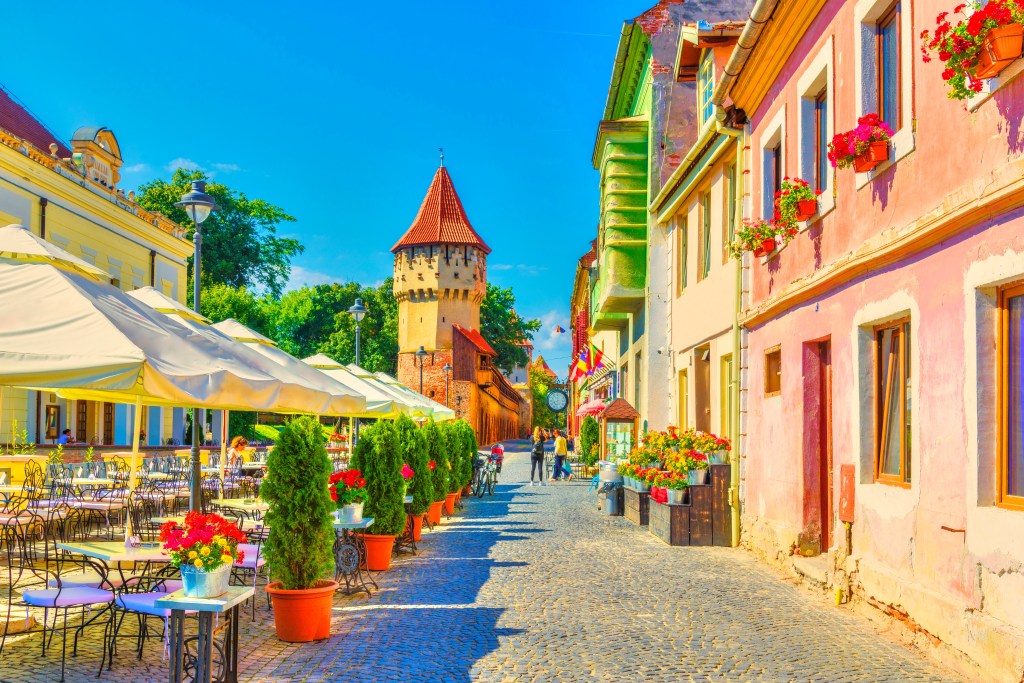
A passage beneath part of the tower leads through to Piața Mică, smaller, as its name promises, with fewer grand facades and more cafe tables. This tends to be where the day slows down, partly because by now an hour or two of cobblestones has started to make itself felt through the soles of your shoes.
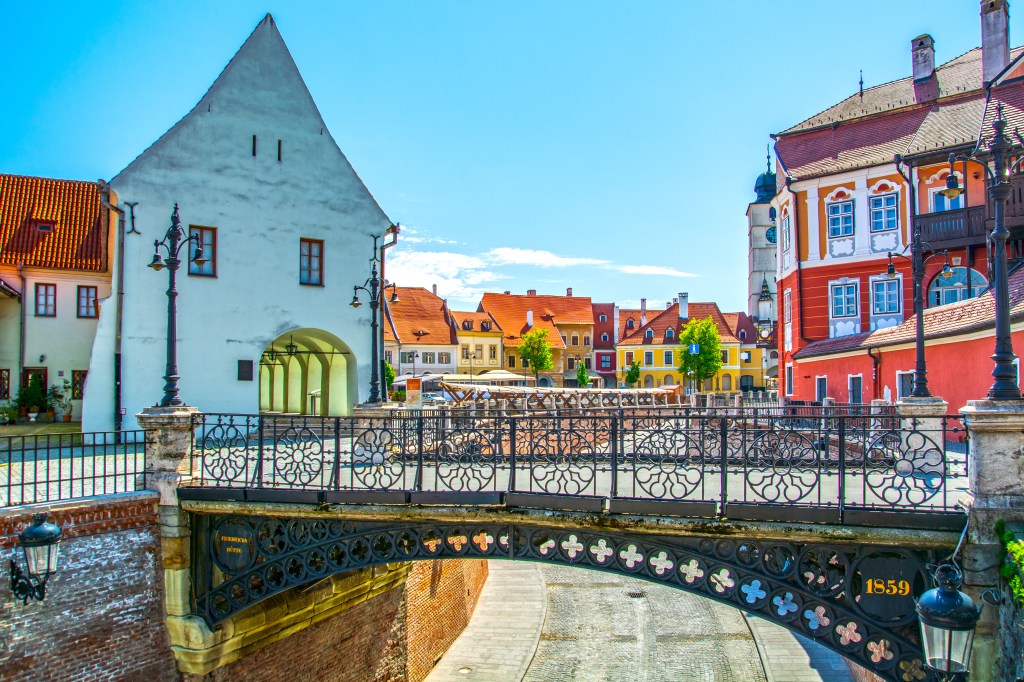
Between the two squares runs the Bridge of Lies, less a bridge than a covered walkway, though it carries both a name and a legend. The story holds that the bridge groans when someone standing on it tells a lie. Where the story comes from, or whether it predates the bridge itself, built only in 1859, nobody seems entirely certain, and the bridge, for what it is worth, remains structurally sound.
Further on, Piața Huet is quieter, dominated by the Evangelical Cathedral and its Gothic tower, which has stood over the city for seven centuries and has, by now, seen most of what there is to see. The square feels less arranged for visitors than the others, which is its own kind of appeal.
Look up at the church tower and you will notice four small turrets at the corners, easy to miss unless someone points them out. They marked, in the language of the time, the right of the city to pass capital sentences, ius gladii, the right of the sword. Sibiu had that right for centuries. The turrets are decorative now, in the sense that everything from that period is decorative now, which is to say they are not, not really.
By early afternoon, hunger arrives, and Sibiu does not complicate this. Strada Nicolae Bălcescu, linking the old town to the newer city, has restaurants that serve Romanian food without translating it for you, the way it should be. A few tables outside, a menu in one language, and the food tends to take care of itself.
One more thing worth knowing, if only because it tends to surprise people. Klaus Iohannis, Romania’s president for over a decade, was born here, into one of the Saxon families whose ancestors built these squares. Most of those families left in the decades after communism, for Germany and Austria, and the Saxon population that once defined the city is now small. But the city they built is still standing, still being walked through, still watching from the rooftops.
Sibiu offers no single overwhelming sight to justify the trip on its own terms, no castle on a hilltop, no canyon, no lake. What it offers instead is a centre small enough to cover on foot in a day, old enough that nearly every street carries some story behind its name, and a detail, those rooftop eyes, that turns an ordinary walk into something quietly stranger than expected.
You leave without a photograph that quite explains why you liked it so much. The eyes do not translate well to a screen. You simply have to stand there yourself, in the square, under all those rooftop eyes, and feel, for a moment, that the city is glad you came.
Getting there
Direct trains from Bucharest take just over 5 hours and cost roughly 25-30 euros. Tickets can be booked directly through CFR Călători. From Brașov, the journey is much shorter, just over an hour by train or car, which is why most visitors combine the two cities rather than treating Sibiu as a separate trip.
Where to stay
Rooms in the old town, often inside converted Saxon houses with thick walls and small windows, run from around 250 RON (50€) for budget options up to 500 RON (100€) or more for boutique stays right on the squares. Staying overnight, even just once, changes the experience: by early evening the day-trippers thin out, and the squares belong to whoever is left.
For accommodation in Sibiu’s old town, check availability on Booking.com.
Where to dine
A full meal in the old town typically costs 60-100 RON (12-20€), more on the main square terraces, less a few streets away. Strada Nicolae Bălcescu, linking the old town to the newer parts of the city, has restaurants serving Romanian food without translating it for you, which is usually a good sign.
If you’d rather not drive or navigate trains yourself, browse Sibiu day tours on GetYourGuide.
This article is also available in French:
You might like:
- Cluj-Napoca: Medieval, Bohemian, Cosmopolitan, and Completely Itself
- Brasov, Romania: The City Where Every Square Feels Like a Holiday
- Sighișoara: The Mistake Almost Every Visitor Makes
© 2026 Secrets of Romania. All rights reserved.
 Secrets of Romania