
Some places survive wars, empires, and centuries. This one didn’t survive progress. Ada Kaleh was an Ottoman island, swallowed by the Danube in 1970 and lost forever.
There is a place in Romania that no longer exists.
Not abandoned. Not forgotten. Not in ruins at the end of a dirt road waiting to be rediscovered. Gone. Completely and deliberately erased, swallowed by thirty metres of Danube water, its minaret dynamited so it wouldn’t disturb river navigation, its houses bulldozed, its graveyard submerged, its people scattered to Constanța and Istanbul with whatever they could carry.
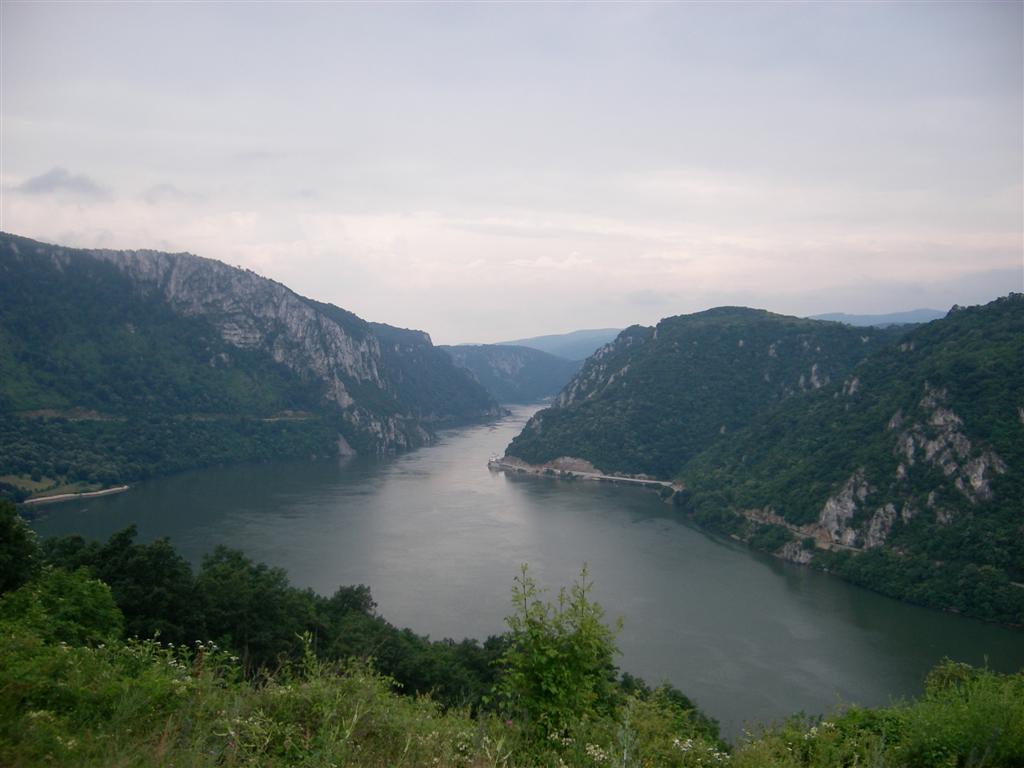
Its name was Ada Kaleh. In Turkish, it means “island fortress.” And if you stand today at the Iron Gates gorge, on the Romanian side of the Danube, looking out at that grey-green water cutting between two walls of rock, you are looking directly at where it used to be.
You just can’t see it anymore.
An Island That Belonged to Everyone and No One
Ada Kaleh was, by any measure, an improbable place.
A narrow strip of sandy soil barely two kilometres long and half a kilometre wide, sitting in the middle of the Danube just downstream from Orșova. Romania on one bank, Serbia on the other. The Carpathians rising on both sides like the walls of a cathedral.
And on this sliver of river island, a community of several hundred Turkish Muslims living as if the Ottoman Empire had never collapsed. Because for them, in a way, it hadn’t. This is their story too, not just Romania’s.
The island changed hands so many times across the centuries that history eventually lost track of it. The Habsburgs wanted it for military control. The Ottomans held it as a frontier post. Bismarck forgot to mention it at the Congress of Berlin in 1878, leaving its status legally ambiguous for decades. After World War I, when the map of Europe was redrawn in Paris and Geneva, Ada Kaleh was forgotten again. The old mayor of the island reportedly loaded the community’s papers onto a donkey and travelled to Bucharest himself, where Romanian politicians were astonished to discover the island existed at all.
It officially became Romanian territory in 1923, under the Treaty of Lausanne, when the new Republic of Turkey ceded it. But the people who lived there were still Turkish. They still spoke Turkish, prayed in their mosque built on the ruins of a Franciscan monastery, made baklava and Turkish delight and rose oil by hand, grew tobacco, caught fish from the Danube, and welcomed the European tourists who stopped their river cruises to spend an afternoon in this impossible little corner of the East that had somehow survived into the modern world.
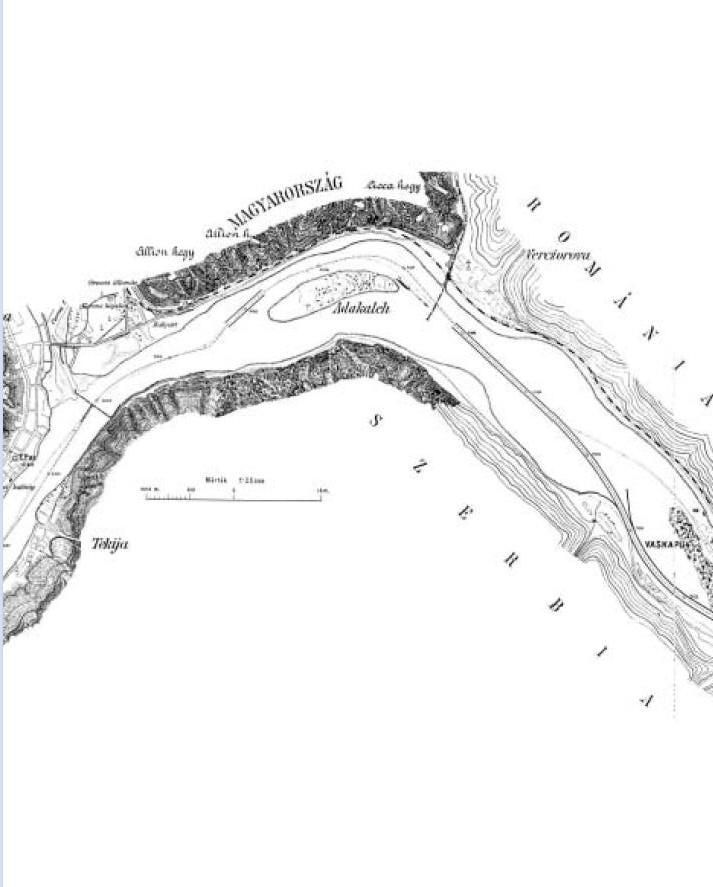
Map of Ada Kaleh island between Hungary, Romania and Serbia, 1918. Source: Wikimedia Commons — Public Domain
The English writer Patrick Leigh Fermor visited in 1934, and what he found stopped him cold. Coffee shops under vine trellises. Old men in turbans playing backgammon in the shade. The smell of tobacco and roses. A minaret reflected in the Danube. He wrote about it years later with the particular ache of someone who had seen something beautiful that he knew wouldn’t last.
He was right. It wouldn’t.
The Island That Survived Everything Except the Twentieth Century
Ada Kaleh had a gift for survival that borders on the miraculous.
It survived being a battleground between two empires for three centuries. It survived being forgotten by every major peace treaty in modern European history. It survived World War I, the collapse of the Ottoman Empire, the collapse of the Austro-Hungarian Empire, the redrawing of every border around it. It survived being absorbed into a kingdom it had never asked to join. It survived World War II. It survived becoming a communist country’s awkward ethnic footnote, fenced off from its own neighbours, visitors forced to surrender their passports at the dock, residents forbidden from crossing to the mainland after eight in the evening.
It survived all of that. What it could not survive was a dam.
In 1964, Romania and Yugoslavia signed an agreement to build the Iron Gates Hydroelectric Power Station, one of the largest hydroelectric projects in Europe at the time. It was progress, the communist kind, the kind that doesn’t ask questions and doesn’t take detours. The dam would flood everything in the gorge that sat below the new waterline. The old city of Orșova. Medieval archaeological sites. Villages. And Ada Kaleh.
There was a plan, briefly, to save the community. The Romanian government proposed moving the island’s structures to nearby Șimian Island and rebuilding Ada Kaleh there. A new Ada Kaleh, a few kilometres downstream. The fortress was partially moved. Then the project stalled, as these projects do, underfunded and underprioritised. The community, seeing what was coming, chose not to wait. Most moved to Constanța, on the Black Sea coast, where Romania’s Turkish minority had always been concentrated. Others went to Turkey, to Istanbul and beyond, carrying their memories and their carpets and their recipes for baklava.
In 1970, the waters rose.
The minaret, which might have stood above the waterline as a kind of monument, was dynamited instead. It was considered a navigation hazard. The buildings were demolished. The graveyard went under. And Ada Kaleh, which had outlasted the Ottoman Empire and two world wars and the Congress of Berlin and the Treaty of Lausanne, disappeared in a matter of months.
Today it lies under thirty metres of water and mud, three kilometres downstream from Orșova, somewhere beneath the surface of the river you are crossing when you drive the DN57 along the Romanian bank of the Danube.
What the Water Couldn’t Take
Here is what remains.
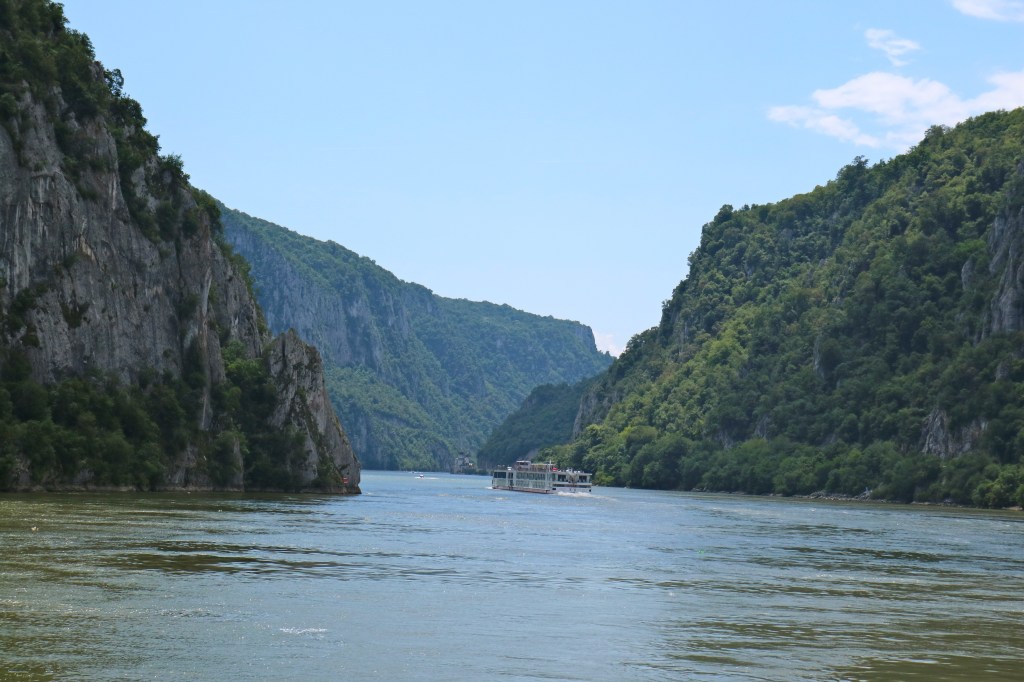
The gorge itself is still one of the most spectacular stretches of river in Europe. The Cazanele Dunării, the Iron Gates canyon, is the narrowest point of the entire Danube. The rock walls rise 300 metres straight out of the water on both sides. The river narrows to less than 150 metres. It is the kind of landscape that makes you understand why people built fortresses here, why empires fought over the right to control this passage, why a tiny island sitting in the middle of all of this felt, to those who lived on it, like the centre of the world.
On Șimian Island, accessible only with special permission, you can find what the Ceaușescu government managed to move before everything fell apart. The fortress walls, partially reconstructed, slowly losing their battle with the river vegetation. A few stone structures. The ghost of a promise that was never kept. It is, as one traveller put it, exactly the right kind of ruin for Ada Kaleh: even the attempt to preserve it became a kind of loss.
At the Iron Gates Region Museum in Drobeta-Turnu Severin, thirty kilometres downstream, you can see what the archaeologists and historians managed to save before the waters came. Objects from the island. Photographs. Documents. The carpet from the Ada Kaleh mosque, a personal gift from Sultan Abdülhamid II, was removed in 1965 and taken to the Mosque of Constanța, where it still lies today.
And in Istanbul and Constanța and in the memories of their grandchildren, the descendants of Ada Kaleh’s last community carry the island with them. The recipes for Turkish delight made with Danube roses. The particular light of a summer evening when the mountains turned purple and the river turned gold and everything on that two-kilometre strip of sand felt, briefly, like enough.
Why You Should Come Here Anyway
The Iron Gates region is one of the most undervisited parts of Romania, which is saying something in a country that is systematically undervisited by the rest of Europe.
The DN57 road along the Romanian bank of the Danube between Moldova Nouă and Drobeta-Turnu Severin is one of the great drives of Eastern Europe. The gorge at Cazanele Mari and Cazanele Mici stops you cold every time. The Decebalus Rock sculpture, the largest rock sculpture in Europe, carved into the cliff face above the water, appears around a bend in the river like something from a dream. The Roman fortifications at Drobeta-Turnu Severin are among the best-preserved Roman ruins in the country.
You come for the landscape. You stay for the history. And somewhere in the middle of all of it, when you stop the car at a viewpoint above the gorge and look out at that grey-green water between the rock walls, you think about a small island that isn’t there anymore. About the people who lived on it. About the roses and the baklava and the old men in turbans and the minaret that caught the light of a Danubian morning for sixty years before someone decided it was in the way.
Ada Kaleh cannot be visited. But the water above it can. The gorge around it can. The museum that holds its objects can. The road that runs along its ghost can.
And sometimes, that is enough.
Practical Information
Getting there: The Iron Gates region is best reached by car. From Bucharest, take the A1 motorway toward Pitești, then follow the DN6 toward Drobeta-Turnu Severin (approximately 3.5 hours). The scenic DN57 along the Danube runs between Drobeta-Turnu Severin and Moldova Nouă.
Where to stay: Drobeta-Turnu Severin is the main town in the area and has several hotels. Orșova, closer to the gorge, offers smaller guesthouses with Danube views.
Iron Gates Region Museum (Muzeul Regiunii Porților de Fier): Located in Drobeta-Turnu Severin. Open Tuesday to Sunday.
Entry approximately 28 RON for adults, 7 RON for children. The Ada Kaleh collection is on permanent display.
Best time to visit: May to October. The gorge is spectacular in all seasons, but summer brings boat tours through Cazanele that allow you to see the canyon from the water.
Boat tours: Local operators in Orșova run tours through the Cazanele gorge between May and September. Prices vary; expect to pay between 60 and 150 RON per person depending on the route and operator.
Romania is not only what you can see. Sometimes it is also what is no longer there.
Romania is worth the detour.
© Secrets of Romania. All rights reserved. Unauthorised reproduction prohibited.
Historical photographs used in this article are in the public domain. Source: Wikimedia Commons.
 Secrets of Romania